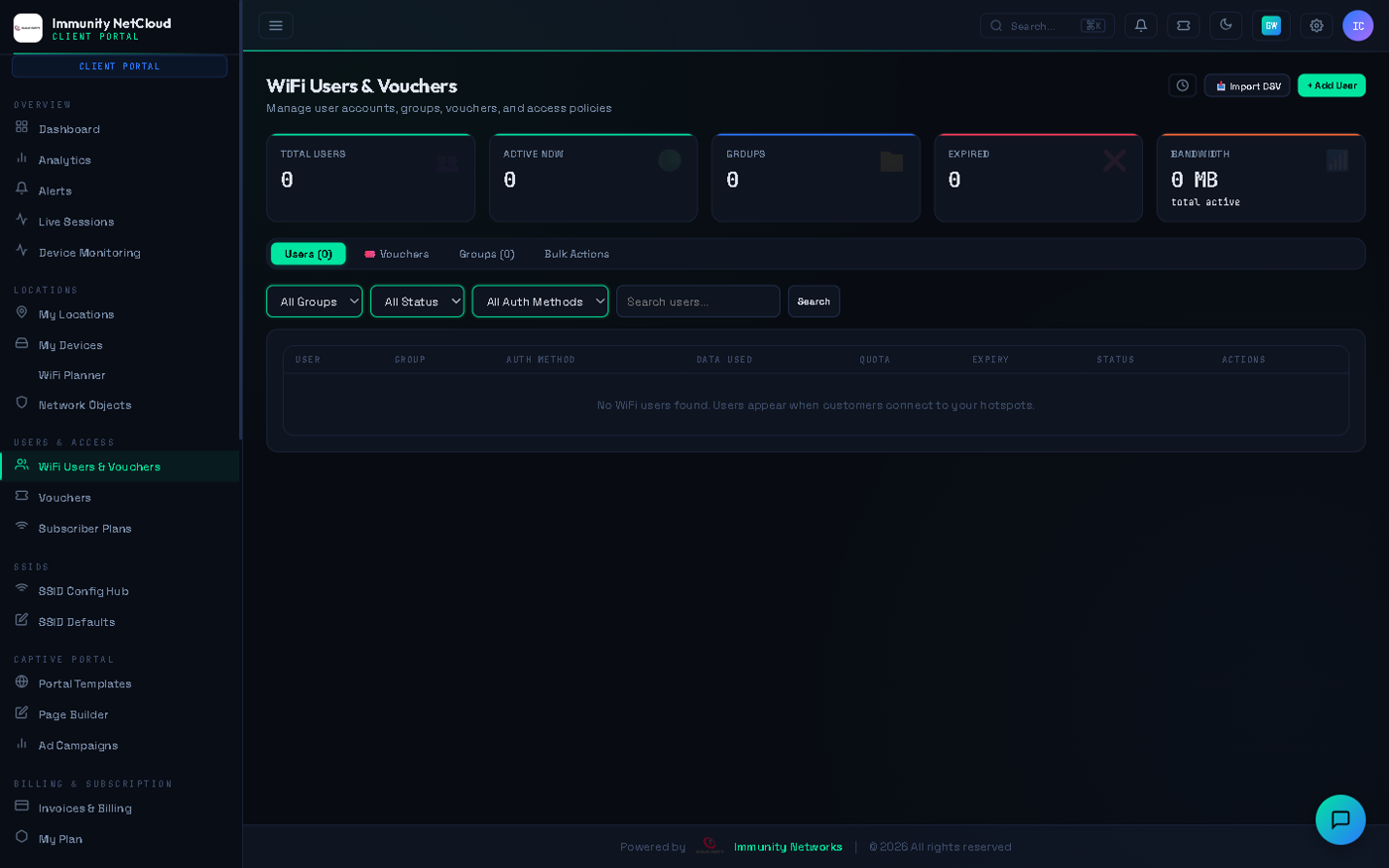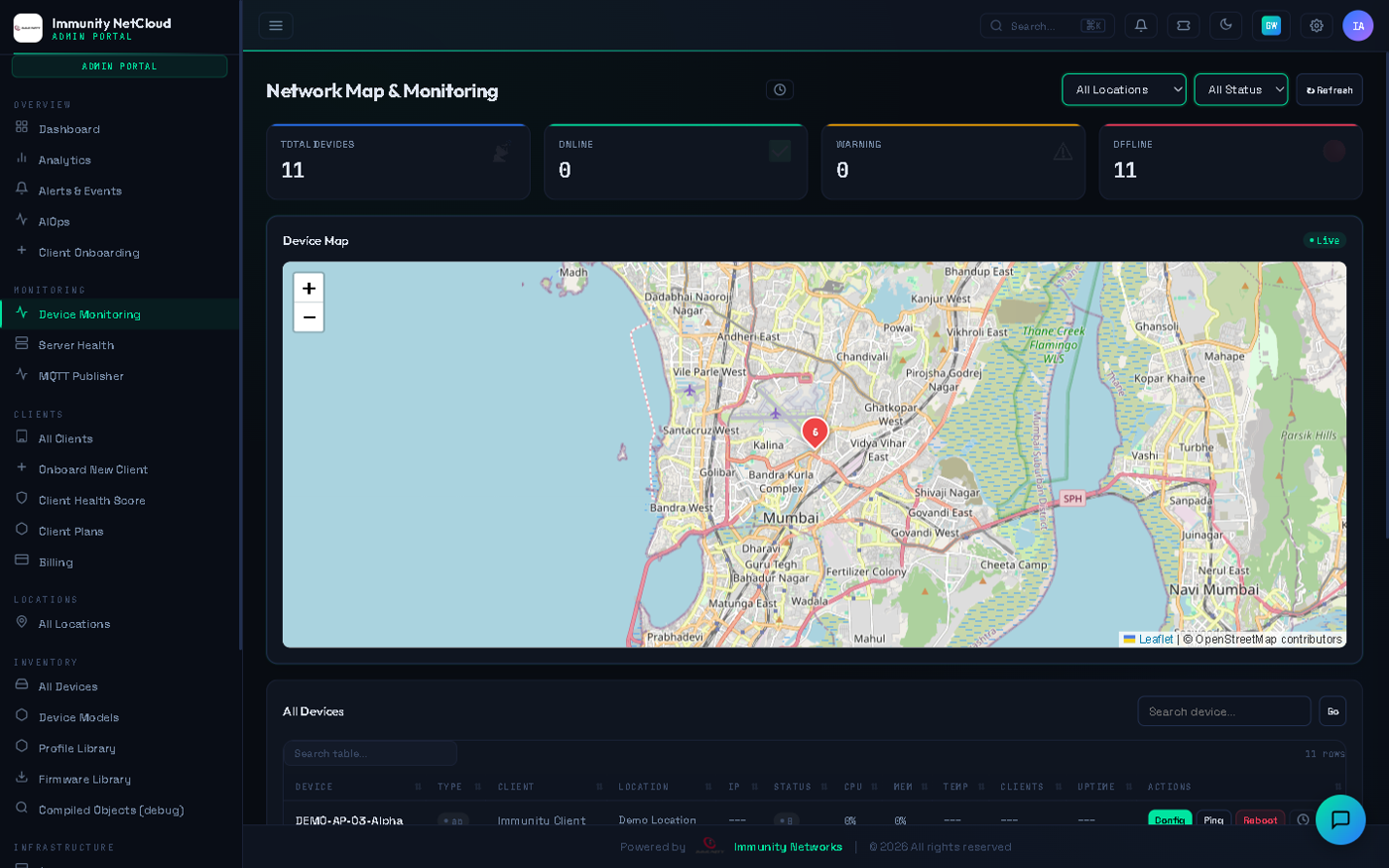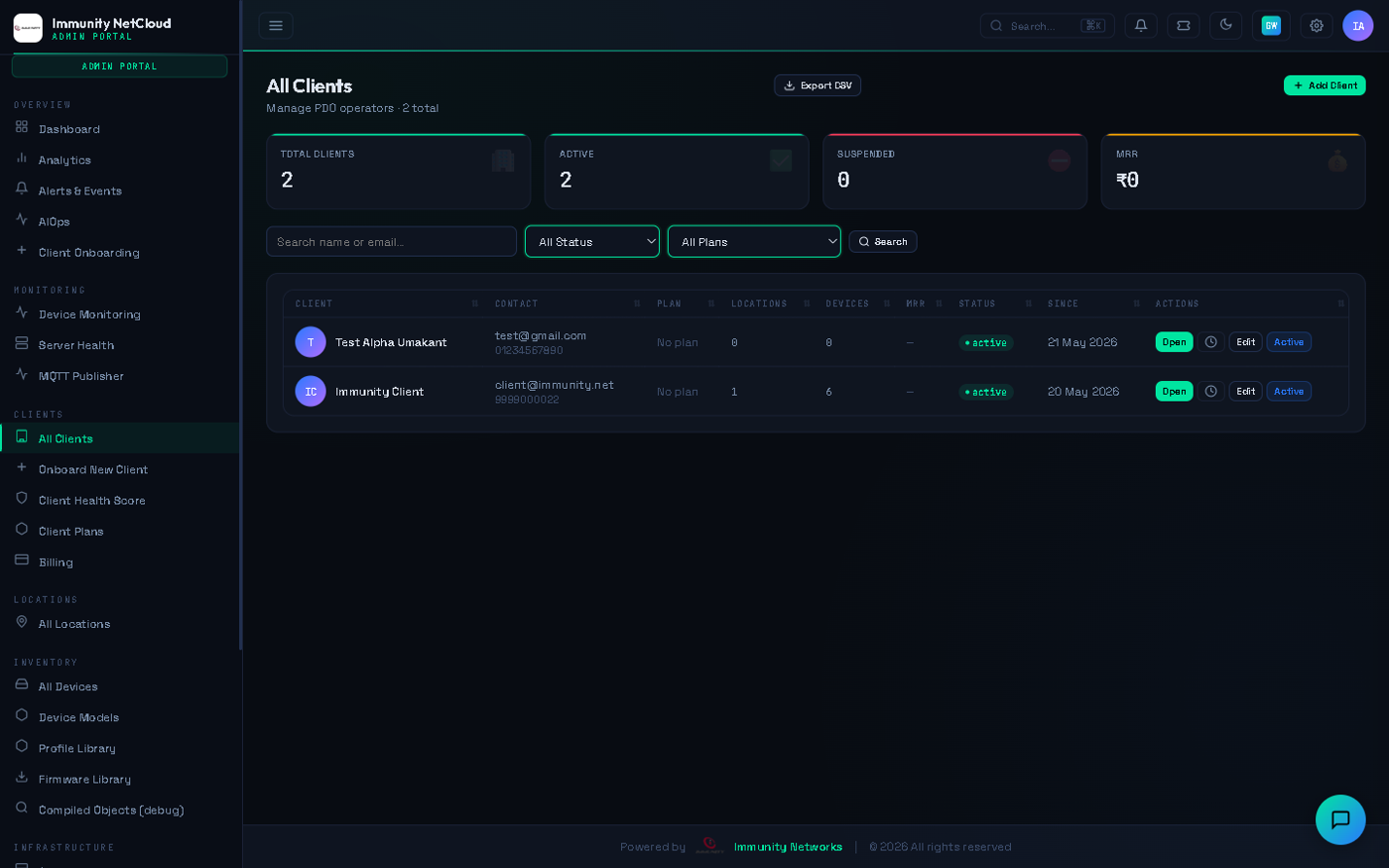
One console for the whole estate. NetCloud Central is the cloud management and AIOps plane for Immunity Networks & Technologies hardware — zero-touch provisioning, multi-tenant administration, per-site dashboards, usage analytics, remote operations, AI-driven radio resource management, anomaly detection, automated remediation, root cause analysis and centralised IPDR logging for PM-WANI compliance. It manages NetWave Wi-Fi access points, NetForce switches and NetGuard controllers from a single pane, so a two-person IT team can run forty sites without living inside a CLI.
Ask a network manager at a multi-campus organisation what their monitoring stack tells them, and the honest answer is usually "everything, all the time, and none of it in order of importance." SNMP polls arrive. Syslog arrives. A dozen link-down traps arrive within the same eight seconds because one upstream aggregation port flapped. Somewhere in that flood sits the single event that actually matters, and a human being is expected to find it while three people from the finance floor are standing at the helpdesk saying the Wi-Fi is slow.
That is the gap NetCloud Central is built for. Traditional monitoring answers the question "is it up?" An AIOps platform is meant to answer a harder set of questions: is this behaviour normal for this site at this hour, what changed, which of these forty alarms are symptoms of one cause, and can the system fix it without waking anyone up. If those distinctions are new to you, our explainer on what AIOps in networking actually means is a reasonable place to start, and the side-by-side on AIOps versus traditional monitoring sets out exactly where threshold-based tooling runs out of road.
The commercial argument is simpler than the technical one. Network operations cost is dominated by people, travel and truck rolls, not by licences. Every incident that requires an engineer to drive to a branch to power-cycle an access point is a cost line. Every ticket that takes forty minutes to diagnose because nobody can correlate a client complaint with a channel change is a cost line. NetCloud Central attacks those lines by moving diagnosis into software and by making remote action the default rather than the exception.
NetCloud Central is a management and analytics plane. Devices in the field carry their own forwarding logic; the cloud carries configuration intent, telemetry aggregation, analytics and the operator interface. That separation matters in Indian deployments, where a site may sit behind a broadband link that is genuinely unreliable — a temple town venue on a rural fibre tail, a warehouse on a 4G backhaul, a district office where the link drops every evening. Configuration is pushed as intent and held locally, so devices continue forwarding traffic and enforcing policy according to their last known good configuration while the management link is unavailable, then reconcile state when it returns. We deliberately make no claim here about controller redundancy, cluster failover or stateful takeover behaviour — those are engineering statements, and if your design depends on them, ask us to confirm current capabilities in writing for the exact firmware and model you are evaluating.
The management channel is initiated outbound from the site. That is a deliberate choice: it means no inbound firewall holes, no public IP requirement per branch, and no VPN concentrator to size and maintain purely for management traffic. For organisations running a lean security team, this removes an entire class of exposure. Where optical transport between buildings is in scope, our NetBeam optics range covers the passive and active layer beneath the switching, and the same console gives you the reachability view across it.
Devices are claimed against your tenant before they leave the warehouse. A site engineer racks the unit, connects uplink and power, and the device pulls its role, VLAN map, SSID set, radio policy and firmware from the cloud. No laptop, no console cable, no serial adapter, no experienced hands required on site. For a rollout of two hundred access points across thirty locations this is the difference between a project and an ordeal.
Organisations, sites and device groups are first-class objects with their own administrators and their own scoped views. A hospital group can give each facility's IT staff control of their own floors while the corporate network team retains estate-wide visibility. System integrators and managed service providers can hold many customers in one login without any customer seeing another's data. Role-based access controls what each operator can see and change, and every configuration action is written to an audit trail.
Each site gets its own view: client count over time, throughput, channel utilisation, retry rates, association failures, DHCP and DNS response health, PoE budget consumed on each switch, uplink saturation. The point is not the pretty graph. The point is that when a user says "it was bad yesterday around four", you can go to yesterday around four and see what the radio environment actually looked like instead of guessing.
Application and client analytics show what the capacity is being spent on — which SSIDs, which device classes, which hours. In a hotel this shapes bandwidth tiers. In a college it justifies the next AP purchase to the finance committee. In a warehouse it shows whether the handheld scanners are roaming cleanly or thrashing between two access points at the aisle boundary.
Reboot a device, bounce a PoE port, change a radio channel, push a firmware ring, roll a configuration back, disconnect a misbehaving client, run a packet capture or a cable diagnostic — from the console. Firmware can be staged by group and by maintenance window rather than pushed to the whole estate at once. Every action is attributable to a named operator.
For public Wi-Fi deployments, Internet Protocol Detail Records are retained centrally in the form and for the period your compliance obligations require, searchable by session, by user identifier and by time window, with an export path for lawful requests. This is the record-keeping backbone under a PM-WANI deployment and it is the part most operators discover late.
The word "AI" attached to a network product deserves scepticism, so it is worth being precise about the mechanism rather than waving at it. NetCloud Central applies statistical and machine-learning techniques at four specific points in the operations cycle, and each of them is a distinct piece of engineering with a distinct failure mode.
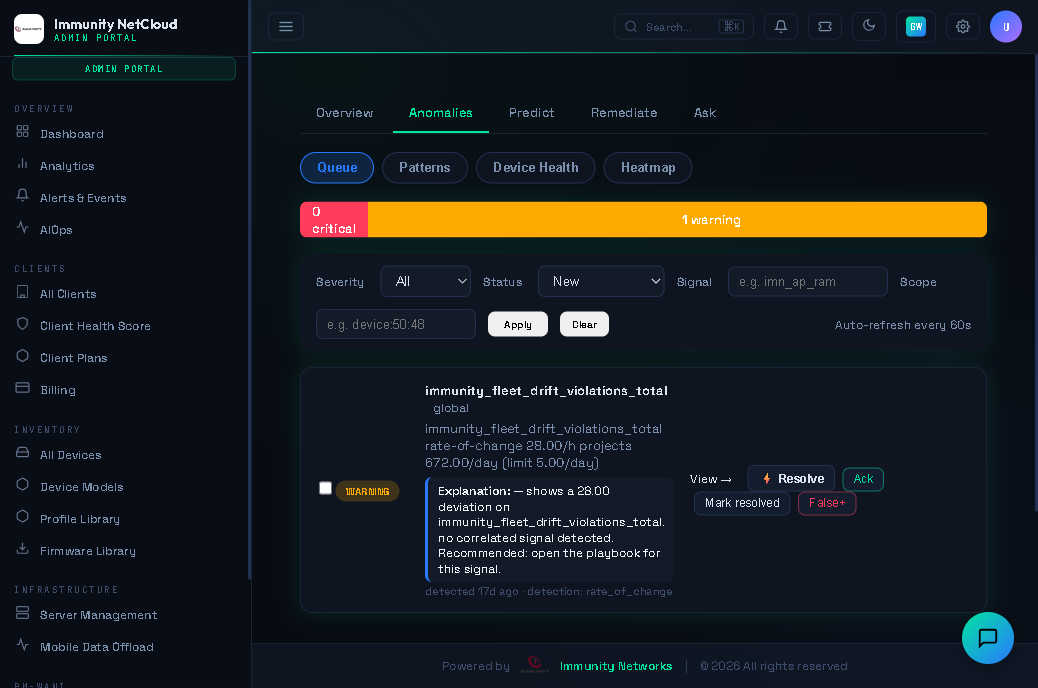
Detect. The platform builds rolling baselines of normal behaviour per site, per radio and per time-of-day, then flags statistically significant departures from them. A hospital's Tuesday morning outpatient block has a different normal from its Sunday night. A static threshold cannot express that; a learned baseline can. The mechanics of building those baselines, and the honest limitations — cold-start periods, seasonality, the risk of learning a broken state as "normal" — are covered in our piece on network anomaly detection.
Diagnose. Correlation is where an operator's time is actually saved. When an aggregation uplink degrades, the console does not present thirty-eight separate incidents; it presents one, with the downstream events attached as evidence and a ranked set of probable causes. Crucially the evidence is visible — you can see why the platform reached its conclusion and disagree with it. A black-box verdict you cannot interrogate is worse than no verdict, and we explain the reasoning chain in AI root cause analysis for networks.
Remediate. Some classes of fault have a known safe action: shift a congested radio to a cleaner channel, trim transmit power where two access points are stepping on each other, bounce a PoE port on a hung camera, roll a configuration back to the last known good version, quarantine a client that is flooding the air with probe requests. NetCloud Central can execute these automatically, or hold them behind an operator approval gate, per class of action and per site. Most customers start fully gated, watch what the platform proposes for a month, and then release the categories they trust. That progression is described in self-healing networks explained.
Learn. Every remediation is scored against what happened afterwards. If a channel change did not reduce retries, that is recorded and weighted. The loop is only as good as its feedback, which is why we take a dim view of any platform that acts without measuring the result.
Radio resource management deserves its own note because it is the capability with the most day-to-day effect on user experience. Channel plans in dense Indian deployments degrade continuously — a neighbouring tenant installs their own equipment, a false ceiling goes up, a new microwave link appears on a rooftop. Static channel plans made at commissioning are stale within months. AI-driven RRM re-evaluates channel width, channel selection and transmit power against observed interference and client distribution rather than against a survey from eighteen months ago, and it does so with hysteresis so that access points do not oscillate. The trade-offs, particularly around 6 GHz and channel width in high-density environments, are set out in AI-driven RRM for Wi-Fi.
We are not going to publish a percentage figure for MTTR reduction or ticket deflection and attach our name to it. Those numbers are a function of your baseline, your team's current process, your device mix and how much of the estate you actually put under management. A vendor quoting you a single headline percentage is quoting you someone else's network. What we will do is tell you exactly which measurements make the comparison meaningful, and encourage you to take them before the deployment rather than reconstructing them afterwards from memory.
Take a four-week baseline of: total network tickets raised, the proportion resolved without a site visit, median and ninetieth-percentile time from ticket raised to root cause identified, number of physical truck rolls and their loaded cost, number of alarms your NOC received versus number of genuine incidents, and time taken to bring a new site live from delivery to service. Then run the same measurements ninety days into production with NetCloud Central. That is a defensible business case, and it is yours rather than ours. Our note on building the AIOps ROI business case works through the arithmetic with a worked template, and if you are running a formal evaluation against other platforms, the AIOps platform buyer's guide lists the questions that separate genuine capability from a dashboard with the word "AI" in the corner. Ask us to confirm current capabilities in writing for the specific firmware and licence tier you are considering — we would rather answer a hard question in a document than have you discover a gap in month four.
One further point on procurement. Indian buyers increasingly require MTCTE registration, TEC approval and WPC clearance as gating conditions in tenders, and the requirements differ by product category and by model, not by brand. Ask any vendor — including us — to confirm in writing which approvals apply to each specific model you intend to purchase, with certificate references, and to state validity dates. Our certifications page sets out how to request that documentation for a proposed bill of materials. Treating this as a paperwork exercise at the end of a procurement cycle is how projects slip.
Hostels, lecture blocks, libraries and administrative buildings each behave differently and each has a different owner. Multi-tenant scoping lets the hostel warden's team manage their own SSIDs while the central IT department keeps the switching fabric and the security policy. Density planning is covered on our campus wireless page.
A multi-speciality hospital group typically runs clinical devices, nurse-call, imaging transfers, guest Wi-Fi and biomedical telemetry over one physical estate with hard segmentation between them. Anomaly detection matters more here than anywhere, because a degradation in a clinical VLAN is not something you want a patient to report first. See hospital Wi-Fi solutions.
Per-property dashboards with a group-level roll-up match how hotel chains are actually run: a general manager cares about their property's guest experience score, the group IT head cares about the estate. Bandwidth tiering, captive portal branding per property and room-level troubleshooting are covered under hotel Wi-Fi solutions.
Immunity Networks is a certified PDO Aggregator (PDOA) under the PM-WANI framework. Separately, and as a distinct commercial arrangement, Immunity is a Public Wi-Fi Partner with BSNL — that is not a PDO role and the two should not be read together. NetCloud Central provides the centralised IPDR retention, session records and audit trail that a compliant public Wi-Fi operation requires. Details on our PM-WANI page.
Branches, depots and regional offices where there is no local IT presence at all. Zero-touch provisioning and remote operations are not conveniences in this pattern — they are the only thing that makes the model viable. See the enterprise networking overview for the wider stack.
System integrators and managed service providers run many customer tenants under one login with strict data separation, delegated administration and per-customer reporting. Commercial terms, demo units and enablement are handled through our partner programme.
Immunity Networks & Technologies Pvt Ltd has been designing and building enterprise networking equipment since 2009, with manufacturing at Sanand GIDC in Gujarat and headquarters in Powai, Mumbai. That matters for a management platform in three practical ways. First, escalations reach engineers in the same time zone who can look at the same firmware branch you are running, rather than a global support queue that hands your case across three continents overnight. Second, feature requests that are specific to Indian regulation and Indian deployment conditions — PM-WANI record-keeping, regional language captive portals, resilience to poor last-mile links, tender documentation formats — go to a roadmap owned in Mumbai rather than being filed behind priorities set for another market. Third, procurement teams working to public-sector local content requirements have a domestic manufacturer to point at with a factory address that can be visited.
Support is delivered against defined response commitments, spares are held in country, and the same team that builds the hardware maintains the cloud platform that manages it. If you want the specifics of the support model, response windows and firmware lifecycle policy for a proposed deployment, ask and we will put them in writing against the exact models and licence tier in scope.
The most useful evaluation is not a slide deck. It is a handful of access points and a switch in one real building, claimed into a tenant of your own, running against your real users for a fortnight. You will learn more from that than from any comparison matrix, and you will have your own numbers rather than ours. Tell us the site, the user count and the constraints, and we will scope a trial.
Devices continue forwarding traffic and enforcing their last known good configuration locally. Management, analytics and remote actions are unavailable until the link returns, at which point buffered telemetry is uploaded and any pending configuration intent is reconciled. We deliberately make no claim on this page about controller redundancy, cluster failover or stateful takeover behaviour — that wording requires engineering sign-off. If your design depends on specific behaviour under link loss, ask us to confirm current capabilities in writing for the exact firmware and model.
It manages NetWave access points, NetForce switches and NetGuard controllers from the same console, with a shared inventory, shared firmware management and correlated event handling across the three. Supported feature depth varies by model and firmware version, so confirm the specific matrix for your bill of materials before finalising a design.
We will not quote a figure, because any single number would be someone else's network rather than yours. What we will do is help you baseline the right metrics before deployment — tickets raised, proportion resolved remotely, median and ninetieth-percentile time to root cause, truck rolls, alarm-to-incident ratio, time to bring a new site live — and re-measure at ninety days. The method is set out in our AIOps ROI business case article. Ask us to confirm current capabilities in writing for the licence tier you are evaluating.
Yes. Auto-remediation is configurable per class of action and per site, and can be set to propose-only so that every action waits for named operator approval. Most organisations begin fully gated, review what the platform recommends over several weeks, and then release the categories they have come to trust — typically radio channel and power adjustments first. Every action, automatic or approved, is recorded in the audit trail with a timestamp and an attributable operator or system identity. Background on the model is in self-healing networks explained.
Immunity Networks is a certified PDO Aggregator (PDOA) under the PM-WANI framework. Separately, Immunity is a Public Wi-Fi Partner with BSNL, which is a different commercial arrangement and is not a PDO role. The two should never be conflated. NetCloud Central supplies the centralised IPDR logging, session records, retention and audit export that a compliant public Wi-Fi deployment needs. Full detail is on the PM-WANI page.
Indian buyers increasingly require MTCTE registration, TEC approval and WPC clearance, and the applicable approvals differ by product category and by individual model rather than by brand. We do not list blanket claims on this page. Ask any vendor, ourselves included, to confirm in writing which approvals apply to each specific model in your proposed bill of materials, with certificate references and validity dates. Our certifications page explains how to request that documentation, and doing so early rather than at award stage avoids schedule slippage.